AI’s Impact Is Outrunning Measurement,If you run a business in Kerala and check your Google Analytics every week, you might feel confident about where your customers are coming from. Google Search, direct traffic, referrals, social — the dashboard tells a clean story.
Except that story might be incomplete.
More and more, customers are asking ChatGPT, Perplexity, or Gemini for recommendations before they ever type your business name into Google. That means AI is shaping who gets considered long before a single trackable click happens.
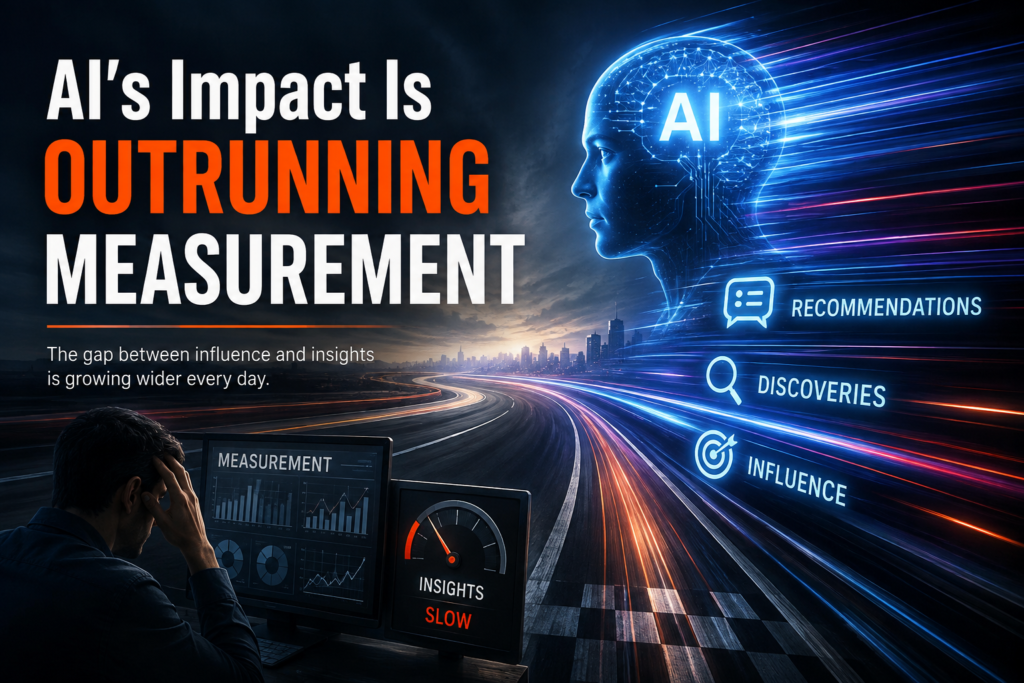
AI’s impact is outrunning measurement , creating what I call the trust and attribution gap facing brands. And it’s quietly rewriting how the best digital marketers in Kerala need to think about measurement, visibility, and customer journeys.
I’ve worked through this problem directly with clients, and I want to walk you through what it actually looks like in practice — not the theory, but the real numbers, the mistakes I’ve seen, and a practical framework you can start using this week.

AI’s Impact Is Outrunning Measurement:Where I First Noticed the Gap
The realization usually comes from a mismatch. Your dashboard says paid search or social drove a conversion because that channel got the last click. But when you actually talk to the customer, they tell a different story — they first heard about you from a ChatGPT recommendation or an AI-generated comparison, researched you there, and only clicked an ad later.
AI’s Impact Is Outrunning Measurement,That’s the moment it becomes obvious: the channel getting credit in your analytics isn’t necessarily the channel that earned the customer’s trust. AI makes this far more visible, because it can influence a decision before the customer ever lands on your website.
A Real Example: What the Dashboard Said vs. What Actually Happened
AI’s Impact Is Outrunning Measurement,One client I worked with, a B2B SaaS company, had a CRM dashboard that looked fairly typical:
| Attributed Source | Reported Share |
| Organic or paid Google | ~62% |
| Direct traffic | ~24% |
| Referrals | ~8% |
| Everything else | ~6% |
AI’s Impact Is Outrunning Measurement ,On paper, Google looked like it was doing almost all the discovery work.
Then we added one simple question to the lead form: “How did you first hear about us?” We also started tracking whether the brand showed up in ChatGPT and Perplexity answers for the kinds of questions prospects were likely asking.
The picture changed. A meaningful share of leads originally bucketed as “direct” or “Google” told us things like “ChatGPT recommended you” or “I asked ChatGPT which tools to use.” The real journey often looked like this:
ChatGPT recommendation → Google brand search → website visit → demo request
AI’s Impact Is Outrunning Measurement,The dashboard wasn’t wrong, exactly — it just couldn’t see the first step. Google got the credit because that was the measurable click, but AI had already shaped the shortlist.
To be clear, I wouldn’t claim we could put an exact dollar figure on what AI generated — that level of precision isn’t defensible with today’s tools. Independent research points to the same structural issue: AI recommendations can increase later branded searches and site visits, even though normal referral attribution never captures the original AI exposure (SSRN research paper).
The fix wasn’t a better dashboard. It was reporting three things side by side: what analytics attributed, where the brand showed up in AI answers, and what buyers themselves said influenced them.
A Simple Framework to Track AI Influence
You don’t need an expensive platform to start closing this gap. Here’s the framework I use, and it works whether you’re a SaaS company or a local Kerala business.
1. Build a fixed prompt set
AI’s Impact Is Outrunning Measurement,Write down 20–50 questions your ideal customers might realistically ask an AI assistant before buying — things like “best tools for X,” “alternatives to X,” or “X vs Y.” Run these same prompts regularly across ChatGPT, Perplexity, Gemini, and Google AI Overviews where it’s available.
2. Track more than just mentions
Don’t stop at “were we mentioned.” Record:
- Where in the answer the brand appears
- Which competitors show up alongside it
- What attributes or descriptions the AI associates with your brand
- Whether the AI actually recommends you, or just lists you
Being mentioned in position eight isn’t the same as being the primary recommendation.
3. Add one first-party discovery question
AI’s Impact Is Outrunning Measurement,Add a simple field to your lead form or checkout flow: “What was the first place you heard about us?” Give options like AI, search, social, referral, direct, and an open “Other” field. This single question gives you a signal traditional analytics simply can’t.
4. Build a monthly AI-influence scorecard
AI’s Impact Is Outrunning Measurement,Compare AI visibility, branded search volume, direct traffic, and leads or conversions side by side each month. You’re looking for patterns, not claiming perfect attribution.
If you want to start this week, don’t buy an AI-visibility tool yet. Pick 20 high-intent prompts, run them manually across two or three AI platforms, log the results in a spreadsheet, and establish your baseline. Repeat the same prompts every week or two.
The real mindset shift is moving from “did AI send us traffic?” to “was AI influencing whether people considered us in the first place?” That second question is where the attribution gap actually becomes measurable.
The Mistake I See Most Often
AI’s Impact Is Outrunning Measurement,the most common mistake is trying to force AI into the same attribution model used for Google, Meta, or email. A brand sees itself mentioned in ChatGPT and immediately tries to calculate exactly how many sales AI generated. That’s false precision, because most AI-driven discovery happens before there’s ever a trackable click.
The second mistake is optimizing for mentions alone. Getting mentioned fifty times isn’t valuable if the AI is describing your brand incorrectly, burying it among five competitors, or never actually recommending it.
Instead, watch three signals together:
- Visibility — Are you appearing for the right high-intent questions?
- Context — What is the AI actually saying about you?
- Business impact — Are branded searches, direct traffic, leads, or customer-reported discovery shifting?
And treat AI attribution as an additional layer on top of traditional analytics, not a replacement for it. The goal isn’t proving “AI generated 37% of our revenue” — it’s understanding whether AI is shaping consideration in ways your existing tools can’t see. That’s a far more honest, and more useful, way to approach it.
What This Means for Kerala Businesses
AI’s Impact Is Outrunning Measurement,This gap isn’t unique to big national brands — if anything, it can be more pronounced for smaller Kerala businesses. That’s not because local businesses are behind. Many have historically leaned on word-of-mouth, Google Maps listings, Instagram, and referrals, so AI-driven discovery is simply a new layer they haven’t started measuring yet.
AI’s Impact Is Outrunning Measurement,there’s already a growing local ecosystem around AI-search visibility in Kerala, particularly in Kochi, even as local SEO remains the essential foundation. Think about how customers phrase things now:
- “What’s the best wedding photographer in Kochi?”
- “Which dental clinic in Thrissur is good?”
- “Best digital marketing agency in Kerala for a small business?”
If an AI assistant recommends three businesses and yours isn’t one of them, you may never know you lost that customer’s consideration. There’s no click, impression, or referral sitting in your Google Analytics to warn you.
There’s a second risk too: what AI says about your business may not match what you’d want it to say. These systems pull from reviews, websites, directories, and other public sources — and inaccurate information can shape a customer’s first impression before you ever get a chance to correct it.
One piece of advice: ask AI about your own business before your competitor does
AI’s Impact Is Outrunning Measurement,this week, open ChatGPT, Perplexity, and Gemini, and ask 10–20 questions a real customer might ask before choosing you:
- “Best [your service] in Kochi”
- “Top [your category] in Kerala”
- “[Your service] near me”
- “Best alternatives to [competitor]”
- “Which [business type] is best for [specific customer need]?”
Write down who gets recommended, whether you appear, what the AI says about you, and which sources it seems to be pulling from. That gives you something far more useful than a vague “AI strategy” — a real baseline of how your business is perceived when customers ask AI for recommendations.
AI’s Impact Is Outrunning Measurement,Don’t abandon traditional SEO or your Google Business Profile to chase this. The stronger approach is building your local search foundation first, then layering AI visibility monitoring on top of it. This combined approach is exactly what separates the best digital marketer in Kerala from someone still reporting last-click numbers as if they tell the whole story.
Frequently Asked Questions
Is AI already influencing customer decisions in Kerala, or is this still mostly a global trend? AI’s Impact Is Outrunning Measurement, It’s already happening locally. Customers researching services like clinics, agencies, or photographers in cities like Kochi and Thrissur are increasingly starting that research with an AI assistant, not just Google.
Can I get an exact percentage of revenue that AI influenced? AI’s Impact Is Outrunning Measurement, Not reliably, at least not yet. The honest approach is tracking directional signals — AI visibility, context, and downstream business impact — rather than claiming a precise dollar figure.
Do I need to abandon my existing SEO strategy to focus on AI visibility? AI’s Impact Is Outrunning Measurement,No. Local SEO and your Google Business Profile remain the foundation. AI visibility monitoring should sit on top of that foundation, not replace it.
How often should I check how AI describes my business? AI’s Impact Is Outrunning Measurement, Every one to two weeks is a reasonable starting cadence using a fixed set of prompts, so you can spot changes over time rather than one-off snapshots.
Key Takeaways
- Traditional analytics often can’t see AI-driven discovery, since it usually happens before a trackable click occurs.
- Add a simple “how did you hear about us” question to your lead forms — it reveals what analytics alone cannot.
- Track AI visibility, context, and business impact together, not mentions in isolation.
- Kerala businesses should ask AI assistants about themselves regularly, using the same prompts a real customer would use.
- Build your local SEO foundation first, then add AI monitoring — this is what a genuinely thorough approach looks like from the best digital marketer in Kerala.
Production Notes (not part of published article)
Suggested Images
- Placement: After the intro — Image prompt: “Split-screen illustration showing a customer journey: a phone with an AI chat recommendation on one side, and a Google search results page on the other, connected by an arrow.” Alt text: “AI recommendation influencing customer journey before Google search”
- Placement: Near the attribution table — Image prompt: “Simple flat-style dashboard graphic showing a pie chart labeled ‘Google 62%, Direct 24%, Referral 8%, Other 6%’.” Alt text: “Marketing attribution dashboard showing channel breakdown before AI influence was tracked”
- Placement: In the Kerala section — Image prompt: “Illustration of a small business owner in Kerala checking a laptop showing AI chat responses, with a subtle Kochi skyline in the background.” Alt text: “Kerala business owner checking AI visibility for their business in Kochi”
Video/Embed Suggestion AI’s Impact Is Outrunning Measurement,A short 60–90 second screen-recording embed showing how to run a prompt like “best digital marketing agency in Kerala” across ChatGPT, Perplexity, and Gemini side by side, would work well after the “Ask AI about your own business” section.
Internal Linking Opportunities
- Link the phrase “best digital marketer in Kerala” (second mention) to a services/homepage URL.
- Link “local SEO foundation” to an existing local SEO service page, if available.
External Reference Used
- SSRN research paper on AI-driven discovery and branded search behavior (do-follow, authoritative academic source).
Schema Recommendation
- Article schema for the main post.
- FAQPage schema for the FAQ section (four Q&A pairs provided above).
Approximate word count: ~1,250 words (excluding production notes).